When the Word is Right (or Write?)

Draft 3

Let me begin by saying that the act of typing this blog post is somewhat counter to the very thing this post is about. Here’s what I want to consider: writing as technology is changed in part by our ability to edit our writing because — for good or otherwise — we can’t see our work being changed.

In her essay “Shitty First Drafts,” Anne Lamott says the first drafts are important:

“You need to start somewhere. Start by getting something — anything — down on paper” (2).

Dennis Baron, in “From Pixels to Pencils: The Stages of Literacy Technologies,” says of the pencil with an eraser, “American schools allowed no crossing out. Teachers preferred pencils without erasers, arguing that students would do better, more premeditated work if they didn’t have the option of revising. The students won this one, too: eraserless pencils are now extremely rare. Artists use them, because artists need special erasers in the work; golfers too use pencils without erasers, perhaps to keep themselves honest. As for the no-crossing-out rule, writing teachers now routinely warn students that writers never get it right the first time, and we expect them to revise their work endlessly until it is polished to perfection” (82).

Do we edit more or less on a computer than by hand? Is the eraser to the pencil what backspace is to the computer? Or, is backspace the intensified eraser because it completely removes? We rewrite a nicer draft by hand; we edit away the bad draft on a computer.

Baron continues,

“We have a way of getting so used to writing technologies that we come to think of them as natural rather than technological” (83).

What’s natural for the technology of writing?

  • The pencil?
  • The typewriter one of my students brought to class last week?
  • The keyboard I’m typing on now?
  • The act of writing, whatever form it takes place in?

Lamott considers, “The first draft is the child’s draft, where you let it all pour out and then let it romp all over the place, knowing that no one is going to see it and that you can shape it later” (1). Is it the first draft, in all its “shitty-ness,” the one that is the truest?

I don’t have definite answers to this question, but my gut response tends toward Lamott. The natural messiness of a first draft seems right, and when I type, I don’t see that transformation. Personally, I like seeing where I start and where I end and that I made it somewhere in the process. If it is a typed first draft, I usually edit by hand so that I can be engaged in the changes that need to be made.

We don’t get to see that change if we don’t have that first draft. Lamott poses,

“Very few writers really know what they are doing until they’ve done it” (1).

Lamott ends her essay, “A friend of mine says that the first draft is the down draft — you must get it down. The second draft is the up draft — you fix it up. You try to say what you have to say more accurately. And the third draft is the dental draft, where you check every tooth, to see if it’s loose or cramped or decayed, or even, God help us, healthy” (2). (Bold font is mine.)

To continue in her metaphor, can we achieve healthy teeth without the brushing and the flossing? Do we need that pencil to best complete the cleaning?

Draft 2

I’d realize that the ideal would likely be that there is time between drafts. But I have one more hour at Starbucks before I need to be back at school for high school graduation tonight, so here goes draft two of three in one sitting:

Let me begin by saying that the act of typing this blog post is somewhat counter to the very thing this post is about. Here’s what I want to consider: writing as technology is changed in part by our ability to edit our writing because — for good or otherwise — we can’t see our work being changed.

In her essay “Shitty First Drafts,” Anne Lamott says the first drafts are important: “You need to start somewhere. Start by getting something — anything — down on paper” (2).

Dennis Baron, in “From Pixels to Pencils: The Stages of Literacy Technologies,” says of the pencil with an eraser, “American schools allowed no crossing out. Teachers preferred pencils without erasers, arguing that students would do better, more premeditated work if they didn’t have the option of revising. The students won this one, too: eraserless pencils are now extremely rare. Artists use them, because artists need special erasers in the work; golfers too use pencils without erasers, perhaps to keep themselves honest. As for the no-crossing-out rule, writing teachers now routinely warn students that writers never get it right the first time, we expect them to revise their work endlessly until it is polished to perfection” (82).

Do we edit more or less on a computer than by hand? Is the eraser to the pencil what backspace is to the computer? Or, is backspace the intensified eraser because it completely removes? We rewrite a nicer draft by hand; we edit away the bad draft on a computer.

Baron continues, “We have a way of getting so used to writing technologies that we come to think of them as natural rather than technological” (83). What’s natural for writing? The pencil? The typewriter one of my students brought to class last week? The keyboard I’m typing on now? Writing, whatever form it takes place in?

Lamott considers, “The first draft is the child’s draft, where you let it all pour out and then let it romp all over the place, knowing that no one is going to see it and that you can shape it later” (1). Is it the first draft, in all its “shitty-ness” the one that is the truest?

I don’t have definite answers to this question, but my gut response tends toward Lamott. The natural, messiness of a first draft seems right, and when I type, I don’t see that transformation. Personally, I like seeing where I start and where I end and that I made it somewhere in the process. If it is a typed first draft, I edit by hand so that I can be engaged in the changes that need to be made.

Lamott poses, “Very few writers really know what they are doing until they’ve done it” (1). We don’t get to see that change if we don’t have that first draft.

Lamott ends her essay, “A friend of mine says that the first draft is the down draft — you must get it down. The second draft is the up draft — you fix it up. You try to say what you have to say more accurately. And the third draft is the dental draft, where you check every tooth, to see if it’s loose or cramped or decayed, or even, God help us, healthy” (2).

To follow in her metaphor, can we get to healthy teeth without the brushing and the flossing? Do we need that pencil to best complete the cleaning?

Draft 1

Let me begin by saying that the act of typing this blog post is somewhat counter to the very thing this post is about. Also, you’ll never know what the first draft of this blog post is. (Except, I just had a great idea: I’m going to in fact share my “shitty first draft.” Hooray for copy and paste.)

Okay, so knowing I”m going for a demonstration of The Shitty First Draft, Here’s what I’m going for (I almost just backspaced to fix me “H” capitalization, but I stopped myself. In typing that explanation, I’ve backspaced multiple times. It seems inevitable).

Here’s what I want to consider: writing as technology has changed in part by our ability to edit our writing, but for good (how nice is it that I can copy and past this text for editing purposes) and for bad– usually we don’t draft as much and we can’t SEE our work being changed.

Lamott says the first drafts are important, “You need to start somewhere. Start by getting something — anything — down on paper” (2). Baron says of the pencil with an eraser, “But American schools allowed no crossing out. Teachers preferred pencils without erasers, arguing that students would do better, more premeditated work if they didn’t have the poption of revising. THe students won this one, too: eraserless pencils are now extremely rare. Artists use them, because artists need special erasers in the work; golfers too use pencils without erasers, perhpaos to keep themselves honest. As for the no-crossing-out rule, writing teachers now routinely wran students that writers never et it right the firs ttime, we expect htem to revise their workd endlessly until it is polished to perfection” (82). Yes, I realize there are typos in this direct quote. It’s my first draft; I’ll fix it later.

Here’s what I’m thinking: Do we edit more or less on a computer than by hand? Is the eraser to the pencil what backspace is to the computer? Or, is backspace the intensified eraser because it completely removes? We rewrite a nicer draft by hand; we edit away the bad draft on a computer. (Except, of course, for this bad draft.)

Baron continues, “We have a way of getting so used to writing technologies that we come to think of theme as natural rather than technological” (83). What’s natural for writing? The pencil? The typewriter a student brought to class last week? The keyboard I’m typing on now? Writing, whatever form it takes place in?

Lamott considers, “The first draft is the child’s draft, where you let it all pour out and then let it romp all over the place, knowing that no one is going to see it and that you can shape it later” (1). Whoops. People will see this first draft. But, back to my point, is a first draft like this one natural and right?

I don’t have definite answers to this question, but my gut response tends toward Lamott. The natural, messiness of a first draft seems right, and when I type, I don’t see that transformation. Personally, I like seeing where I start and where I end and that I made it somewhere in the process. Lamott writes, “Very few writers really know what they are doing until they’ve done it” (1). We don’t get to see that change if we don’t have that first draft. Of drafts, Lamott ends her essay, “A friend of mine says that the first draft is the down draft — you mnust get it down. THe second draft is the up draft — you fix it up. You try to say what you have to say more accurately. And the third draft is the dental draft, wher eoyu check every tooth, to see if it’s loose or cramped or decayed, or even , God help us, healthy” (2).

To follow in her metaphor, can we get to healthy teeth without the brushing and the flossing? That, at least for this first draft, is where I’ll leave you.

Works Cited

Baron, Dennis “From Pencils to Pixels: The Stages of Literacy Technology.” Passions, Pedagogies, and 21st Century Technologies. Ed. Gail Hawisher & Cynthia Selfe. Utah State UP, YR, pp. 15-33. 

Lamott, Anne. “Shitty First Drafts.” Language Awareness: Readings for College Writers, ed. by Paul Escholz, Alfred Rosa, and Virginia Clark, 9th ed., Bedford/St. Martin’s, 2005, pp. 93-96. Writing, Rhetoric, and Digital Studies, University of Kentucky, pp. 1-2, wrd.as.uky.edu/sites/default/files/1-Shitty%20First%20Drafts.pdf.

The Old is New

“We’re taking words and translating them into images” (“The Saint John’s Bible” 2:13-2:17)

Father Michael Patella

My dad attended St. John’s University in Minnesota for his undergrad, and while in some ways it’s just another private university, something that always made it unique when we’d stop by on childhood summer trips to Minnesota was the monastery in the middle of campus. As my dad would start reminiscing, he’d remember monks by name and check with the information desk to see if any of them– his former professors–were on campus.

While going to Minnesota to see relatives and stop by St. John’s happened fairly often, we also received regular mail from the University, and from that mail and from relatives who bought coffee-table books or framed portions, I watched The Saint John’s Bible go from a concept to a realization. The Saint John’s Bible is a completely hand-written and illustrated production of the Bible completed over years of time with the collaboration of both monks and artists.

This week as we’ve read about handwriting, images, memory, and knowledge, among other things, this Bible is the familiar reference my mind keeps turning to.

In Mary Carruther’s chapter “Memory and the Book” from The Book of Memory, she writes about early manuscripts that followed principles that are evident in the work of The Saint John’s Bible. Carruthers writes, “It is not, in our sense, a picture of some thing but rather the means for memorizing and recollecting the same matter or story that written letters also record” (222). She continues shortly after, “Both textual activities, picturing and reading, have as their goal not simply the learning of a story, but learning it to familiarize and domesticate it, in that fully internalized, even physiological way that medieval reading required” (222).

Pictures used in this sense are used to reinforce and memorialize the text that the images support. Referring to a quote by Giraldus Cambrensis, Carruther explains, “figures grouped in the picture are designed both to recall and to stimulate further mental image-making in the reader” (255).

Carruther gives these near-final thoughts in her chapter: “the page is designed to make one meditate upon it, to look and look again, and remake its patterns oneself; the process of seeing this page models the process of meditative reading which the text it introduces will require” (257). The text and the images are interconnected in both purpose and meaning, and the combination of the two strengthens the message of the text.

Here, the lead calligrapher talks about his role in creating the text. Note the use of technology to help him in this “by-hand” production (“Donald Jackson”).

Donald Jackson explains that even in his design of the font for The St. John’s Bible, he considered how to capture the content with how the calligraphy was designed: “its like an orchestral composition. There are going to be places where they are going to be trumpets blowing . . . . There are going to be places where you have serenity” (3:20-3:33).

This video explores the importance of images in understanding the piece and its text from the perspective of one of the monks that led the project (“The Saint John’s Bible”).

Father Michael Patella describes The Saint John’s Bible as a process of “illuminating the Bible” (0:35-0:40). He says, “I realized that art and theology cannot be separated. . . . We’re taking words and translating them into images” (2:06-2:17). He explains, “I myself use it in my classroom . . . and right away I notice that when they can look at an image instead of reading a text, all the barriers go down” (3:37-3:48).

Jackson and Patella both realize the application of Carruther’s work, that text is experienced with images in a way that is remembered, and with that memory, there is lasting impact.

While my dad didn’t choose to attend St. John’s University for it’s future influence on my master’s education, it’s exciting to see how my learning now connects to so much of my life experience and deepens those experiences by giving them contexts they didn’t have before.

Works Cited

Carruthers, Mary. “Memory and the Book.” The Book of Memory. Cambridge U.P, 1990, pp. 221-220. 

“‘Donald Jackson: The Calligrapher’ — The Saint John’s Bible.” Youtube, Canton Museum of Art, 20 Feb. 2013, https://www.youtube.com/watch?v=pTS5m59DPoo.

“The Saint John’s Bible – Father Michael Patella.” Youtube, The St. John’s Bible, 24 Aug. 2016, https://www.youtube.com/watch?v=B24AM6sPYK8.

A Literacy of People

My digital literacy narrative that might broaden how you think of literacy.

Literate: “having knowledge or competence”

Merriam-Webster Dictionary

In my video, I talk about two ways to be “literate” in people: listening and asking questions. Right there, I have already made the assumption that the person viewing my video can easily accomplish both of these tasks.

If someone asked me a week ago how well I attended to accessibility with students or with people generally, I likely would have rated myself fairly high. I would have done the same related to my knowledge of accessibilities and abilities. After all, I took one class in college on the topic.

However, I’ve learned there were areas I am missing and intentionality I am lacking. While there are some things I will change in my teaching and certainly things I will be aware of if I ever teach at a school that accepts students with a broader rage of abilities, the connection I made to accessibility isn’t so much with those I currently teach as with those I hope to teach in the future, whose own literacy narrative I want to be a part of.

Underground Writing is a nonprofit in the community I live in. I’ve known of the program for about a year and have listened to the bi-weekly podcast for that time. I eagerly anticipated the publication of a book of poetry from this organization a few months ago, and read it, finding that it is one of those collections of experiences and ideas that settles in the back of my mind. According to the their website, Underground Writing is “a literature-based creative writing program serving migrant, incarcerated, recovery, and other at-risk communities in Northern Washington through literary engagement and personal restoration.”

This program is in many ways about accessibility. No, not accessibility related to technology but certainly related to communication, to people, to listening and asking questions. Underground Writing provides what vulnerable groups of people don’t often receive: education, creativity, instruction, outlet, care. They take something that I teach as an elective that any student can take at my school, and instead, they offer it to writers whom otherwise might be sitting in their cells.

Today, I had the opportunity to have coffee with the executive director of this program, Matt Malyon. He shared about his perspective on teaching these populations and providing a type of accessibility for them as students who often are missing anything like creative writing in their lives. The website additionally shares, “Honoring the transforming power of the word, we believe that attentive reading leads to attentive writing, and that attentive writing has the power to assist in the restoration of communities, the imagination, and individual lives.”

I don’t know exactly where this increasing interest and literacy will lead me besides the library to check out some of the books Malyon recommended, but as I anticipate moving over the summer and being in a new community, I’m eager to see how I can be part of a sort of accessibility in this growing area of people-literacy in my life.

Works Cited

Malyon, Matt. Personal Interview. Underground Writing,3 Apr. 2019.

“Literate.” Merriam-Webster Dictionary, 2019,
http://www.merriam-webster.com/dictionary/literate#h1.

“Our Story.” Underground Writing. 2019, undergroundwriting.org/our-story.

A Review of RiP!: A Remix Manifesto

After it was referenced in relation to archive, I watched RiP!: A Remix Manifesto. While it isn’t a source that I’ll be using for my Box Logic Project, as a documentary about the society I live in, I left the film intrigued.

Recently, I was discussing a Marvel movie with my brothers that I hadn’t seen, and as I received their spoiler-free feedback, I found that what I really wanted to know was if the film accomplished it’s goal: a blend of action/adventure and comedy with a little romance and a smattering of some deeper-meaning. As I consider RiP!, I applaud it’s ability to accomplish what its greatest goal seemed to be: to make people aware of current copyright laws and norms and to offer forms of response. I finished the movie informed and thoughtful toward how the content of the film might apply to my own use of media.

Framed within four main points, examples like that of Walt Disney remediating fairy tales but prohibiting others from remediating his own work stood out to me. Obviously, the Girl Talk example that carried through the film also brought emphasis to Brett Gaylor’s point. How can creativity be illegal? Should it be? Can creativity be owned? Is regulation needed for the sake of the product or for the purpose of profit?

As a film (from the perspective of a non-expert film-reviewer), the quality certainly wasn’t stunning. However, again, as I think of the purpose of the film as a whole, it wasn’t meant to express high-quality feats of music or cinematography but to document a topic and inspire a response. So, while it probably didn’t end up on the Oscar short-list for best documentary, my guess is it inspired more active response than many documentaries do.

So, what’s my verdict? It’s worth a watch. In the spirit of this assignment, how does my “watch” apply to me? What does it implicate for me as a viewer who is not longer ignorant of its content? I’ve got three answers in no particular order.

1.Be aware of creativity: In my own work and life, I cite things in MLA format, but I don’t often think about the legal aspects of the particulars of what I produce, share, reference, etc. The little bit of “rebel” in me doesn’t want to be held back by the silly legalities explained in this film, but the other side of me recognizes that I am a person under authority and that unless it’s truly a battle I want to fight, I need to be intentional about follow the legal standards of use.

2. Be bold in creativity: While I don’t plan on becoming the next law-breaking version of Girl Talk, I want to consider how I can creatively be a part of remediation, whether that’s of music or fairy tales. The creativity expressed in this documentary was ingenious, both in the making of it and in those documented in it. How can I challenge myself to try new things in the areas of creativity I love: writing, sometimes fine arts, etc.?

3. Be vocal about creativity: As a teacher, I have a role in communicating about the both creativity as an area of legality and as an area of boldness. This video gives context for why I teach my students how to cite their sources, and it gives me ideas for ways I can encourage them to try new things.

Gaylor, Brett, director. RiP!: A Remix Manifesto. Performance by Greg Gillis, Disinformation, b-side, 2009.

Filling the Box [Logic] #3

General Notes

At this point in research, my goal seems to be a “thinning” of the box content. But, while some elimination of less-relevant sources did happen, I also added a few sources, some referenced in Erin Anderson’s The Olive Project and others from a more general search for oral history information on Gardner-Webb’s online library resources. Mary Marshall Clark’s “Oral History” offers an excellent overview of the genre and its history.

The oral histories I’m going to focus on are the New American Story Project and the “Arab Refugee Oral History” archives. These two archives have a similar purpose of telling the stories of those who have recently arrived in the US. While others, like the Ellis Island collection, do as well, these are interesting collections for their currency and for their differing sources. NASP is a nonprofit speaking to current culture. “AROH” is a project completed by students at Duke University.

Refined Works Cited

Anderson, Erin A. The Olive Project. Kairos: A Journal of Rhetoric, Technology, and Pedagogy, vol. 15, no. 2, 2011, kairos.technorhetoric.net/15.2/topoi/anderson/index.html.

  • Background page: “my process seeks to illuminate the inevitable, irreconcilable gap between a life lived and a life narrated.”
  • Background page: “This project is grounded in a central understanding of oral history as a co-constructed process of narrative composition.”
  • The multimodal example of an oral history is intriguing. Anderson uses video, audio, images, and writing in combination.

“Arab Refugee Oral History.” Humanities Writ Large, Duke: Trinity College of Arts and Sciences, 2019, 
humanitieswritlarge.duke.edu/projects/arab-refugee-oral-history.

  • The variety of stories here keep a listener clicking. They are all audio recordings. Some are from first-generation immigrants and refugees, and other recordings are from people who have lived in the US for years or for all their lives. Interviewees are of Middle-Eastern descent and are sharing their experiences.
  • Transcripts are provided, and the few interviews that are in Arabic are translated.
  • The oral histories are collected by students as part of service-learning projects for courses at Duke. Looking a little deeper into the website, I found that there are also oral history collections related to other backgrounds represented around Duke and in Durham.

Clark, Mary Marshall. “Oral History.” Encyclopedia of Life Writing: Autobiographical and Biographical Forms, edited by Margaretta Jolly, Routledge, 1st ed., 2001. Credo Reference, ezproxy.gardner-webb.edu/login?url=https://search.credoreference.com/content/entry/routlifewrite/oral_history/0?institutionId=5562.

  • ” Oral history is a practice of collecting, preserving and interpreting information about the past through the study of both individual and social experiences in story form. It is distinctive from ethnography, where the focus is on writing about the culture of a contemporary community from the investigator’s point of view. While oral history, as a life-writing genre, borrows from autobiography, it is centered on the collision between autobiography and biography, representing at least two perspectives on history, and yielding many more.”
  • “Debates have focused on five themes: truth and bias, particularly in the early days in which personal memory was often seen by traditional “document-based” historians as an unreliable form of historical “evidence”; the interviewer-interviewee relationship; the method’s usefulness for representing minority or hitherto unheard constituencies; individual versus collective memories and voices; and lastly, as stated above, the tension between oral and written forms.”
  • “For the first few decades of its development, oral history was largely identified with the creation of archives, through the work of social historians and others who were concerned with documenting the history of those whose lives might otherwise remain unrecorded. This was particularly true in the England and the United States where the excitement about oral history reflected the passions of popular culture as well as a desire to create an intergenerational record.”
  • “oral history to be used to document history that would otherwise go unrecorded, and simultaneously began to develop a methodology that would lend historical validity to oral history as empirically verifiable data.”
  • “By the late 1970s oral history was identified as an almost exclusively archival practice, with programmes in many parts of the world, but notably in Latin America and the United States.”
  • “United States’ historian Barbara Tuchman declared that “oral history gathered trash and trivia with all the discrimination of a vacuum cleaner”.
  • “incredible diversity of subject matter, political opinion, and literary form that characterizes oral history “

Featherstone, Mark. “Archive.” Theory, Culture & Society, vol. 23, no. 2-3, 2006, pp. 591–596, doi:10.1177/0263276406023002106.

  • “Increasingly the boundaries between the archive and everyday life become blurred through digital recording and storage technologies” (591).
  • “it was possible to ‘tell history as it was’ through careful scrutiny of the treasure-house of material from the past, accumulated in the archive awaiting the historian’s gaze to bring it to life” (592).
  • “It offers the delights of discovering records and truths that have been hidden or lost, of resurrecting the past” (593).
  • “the archive cannot provide a direct access to the past, but only a textual refiguring of it. The archive fever is the attempt to return to the lived origin, to the everyday experience which are the sources of our distorted and refracted memories whose transience and forgetting makes us uneasy” (596).

Featherstone, Mark. “Archiving Cultures.” British Journal of Sociology, vol. 51, no. 1, London School of Economics, 2000, pp. 161–184, doi-org.ezproxy.gardner-webb.edu/10.1111/j.1468-4446.2000.00161.x.

  • “Archive reason is a kind of reason which is concerned with detail, it constantly directs us away from the big generalization, down into the particularity and singularity of the event. Increasingly the focus has shifted from archiving the lives of the good and the great down to the detail of mundane everyday life” (161).
  • “the new electronic archives will not only change the form in which culture is produced and recorded, but the wider conditions under which it is enacted and lived as well” (161).
  • “The archive is the site for the accumulation of primary sources from which history is constructed” (168).
  • “The archive fever is to attempt to return to the lived origin, the everyday experience, which is the source of the imperfect and distorted memories which are our archives and whose transience and forgetting makes us uncomfortable (Derrida 1996: 92)” (170).

Gane, Nicholas and David Beer. “Archive.” New Media: The Key Concepts, Berg, 2008, pp. 71-86.

  • “archiving is related to yet clearly distinct from history. Whereas archives gather and record data, history sketches out narratives and links together selected parts of the archive into what might be called knowledge” (83).

Gluck, Sherna Berger, et al. “Reflections on Oral History in the New Millennium: Roundtable Comments.” The Oral History Review, vol. 26, no. 2, 1999, pp. 1–27. JSTOR, http://www.jstor.org/stable/3675587.

  • “Oral history has always been formed by interaction and change. Oral memoirs pivot upon a unique interaction between historian and historymaker. Changing or redefining the subject of history-~integrating the actions, experiences, and ideas of “ordinary” women and men-is crucial to the attraction of oral history. And the promise of oral history goes further, seeking to transform the relationship between historian and audience, looking for ways to make study of history more accessible, more engaging, and ultimately more participatory. For inherent to oral history are the democratic notions that everyone can be a historian; that memory is in itself a meaningful form of historical interpretation; and that, through oral history projects, students and others can make a meaningful contribution to our understanding of the past” (16-17).
  • “The oral quality of oral memoirs is, in many ways, essential to their meaning. In conversations and in interviews, we convey meaning with pitch and tone of voice, giving cues both subtle and obvious to our listeners. Pacing and pauses, volume and inflection, pronunciation of words and sounds that are not even words-coughs, sighs, exhalations, and moans-all give nuance and depth to the choice of words themselves. Some speakers are almost singers, playing their voices as instruments. Transcription, no matter how skillful, inevitably flattens the spoken quality of oral memoirs. Reading a transcript and listening to the interview are vastly different experiences. While not the same as witnessing the original interview, listening to a recording connects us to the speaker both affectively and cognitively, facilitating empathy and deepening our understanding” (21).

Hannoum, Abdelmajid. ” Paul Ricoeur On Memory.” Theory, Culture & Society, vol. 22, no. 6, SAGE, 2005, 123-137, doi: 10.1177/0263276405059418.

  • “one does not just remember, but one rather remembers something. There is hence memory as an aim (visée) (act and action) and remembrance as the thing aimed at (le souvenir comme chose visée)” (125).
  • “Narratives are made of recollection and of forgetfulness” (126).
  • “But as narratives they are constructed, and as such this construction is motivated and oriented, not only by truth, but by good. This is to say that morality regulates narratives of memory” (127).

Maas, Winy, et al. Information Is Alive: Art And Theory On Archiving And Retrieving Data. NAi Publishers, 2006.

  • Supposedly the book was delivered yesterday, but it wasn’t in my mailbox. I’m waiting to hear from my landlords that live above me to see if they had it delivered to their door.

New American Story Project. 2019, newamericanstoryproject.org.

  • “We want you to see them—refugees in our community—and ask, ‘Who are they? Why are they here? What are their stories? How can I support immigrants in my own community?'”
  • “We believe that stories have the power to illuminate, to educate, and to increase empathy. Stories create change.”

Ochs, Elinor, and Lisa Capps. “Narrating the Self.” Annual Review of Anthropology, vol. 25, 1996, pp. 19–43. JSTOR, http://www.jstor.org/stable/2155816.

  • “Across cultures, narrative emerges early in communicative development and is a fundamental means of making sense of experience. Narrative and self are inseparable in that narrative is simultaneously born out of experience and gives shape to experience. Narrative activity provides tellers with an opportunity to impose order on otherwise disconnected events, and to create continuity between past, present, and imagined worlds. Narrative also interfaces self and society, constituting a crucial resource for socializing emotions, attitudes, and identities, developing interpersonal relationships, and constituting membership in a community” (19).
  • “Narratives are not usually monomodal, but rather they integrate two or more communicative modes. Visual representation, gesture, facial expression, and physical activity, for example, can be combined with talk, song, or writing to convey a tale” (20).
  • “Narrative mediates this involvement. Personal narratives shape how we attend to and feel about events. They are partial representations and evocations of the world as we know it” (21).

Oral History Association. 2019, http://www.oralhistory.org.

  • The “OHA Statement on Diversity and Inclusivity” addresses the ideas of the two oral history archives I’m going to be focusing on for this Box Logic.
  • There are other potential resources on this site related to best practices, etc. that might be useful, too.

Filling the Box [Logic] #2

General Notes:

  • I briefly returned to the “Box Logic” essay in Writing New Media and determined that, while still a fascinating article, it won’t be a source I’ll return to for this oral history/archive Box Logic.
  • I haven’t had a chance to read all of the articles listen below in their entirety but have read enough to know that most or all of them will be useful moving forward. As I consider a focus for this Box Logic, I’m especially interested in the current collections of oral histories as a means for communicating both recent events through people’s stories. It’s still a broad topic, but I think likely I’ll narrow my focus on one or two archives of oral histories and then see what the theorists and academics below have to say in relation to those oral history collections.

Additional Resources:

Gane, Nicholas and David Beer. “Archive.” New Media: The Key Concepts, Berg, 2008, pp. 71-86.

The sources references in the “Archive” chapter of New Media: The Key Concepts, as well as the “Annotated Guide to Further Reading” and the “Bibliography” provided academic resources for my work. The sources below are primarily from those references or from references I found as a result of researching those references. The chapter itself offers a great over

Story Corps. Story Corps, Inc. 2019, https://storycorps.org/.

A friend recommended these stories as another layer of examples to consider in the world of oral histories. As with many oral history archives that I’m finding, the goal is giving voice to those stories that might otherwise not be heard. Diversity, representation, advocacy, respect, and preservation are themes I see developing both here and across many of the collections I’m finding. At this point, the New American Story Project is likely the collection I will focus on, but it’s still interesting to see the variety of what is out there.

Featherstone, Mark. “Archiving Cultures.” British Journal of Sociology, vol. 51, no. 1, London School of Economics, 2000, pp. 161–184, https://doi-org.ezproxy.gardner-webb.edu/10.1111/j.1468-4446.2000.00161.x.

“Archiving Cultures” considers what is involved as places and peoples are archived. How is a culture and a history respectfully archived? How does that preservation produce both permanency and change?

Featherstone, Mark. “Archive.” Theory, Culture & Society, vol. 23, no. 2-3, 2006, pp. 591–596, doi:10.1177/0263276406023002106.

Another piece by Featherstone, here he writes about the role of government in archive and how archive as a technology might vary the quality of the information as compared to traditional archives. Featherstone seems to be one of the primary voices on Archive, so his two pieces will be pieces I definitely read in detail.

Maas, Winy, et al. Information Is Alive: Art And Theory On Archiving And Retrieving Data. NAi Publishers, 2006.

Several essays referenced by Gane and Beer are in this anthology. I’ve ordered it on Interlibrary Loan, so hopefully I’ll be reading in it soon.

Hannoum, Abdelmajid. ” Paul Ricoeur On Memory.” Theory, Culture & Society, vol. 22, no. 6, SAGE, 2005, 123-137, DOI: 10.1177/0263276405059418.

This piece is a discussion and review of Ricoeur’s book, which has three sections “Of Memory and Reminiscence,” “History/Epistemology,” and “The Historical Condition.” Hannoum through Ricoeur considers theorists’ perspectives on memory and history and closes with considerations of memory’s manipulation, which then points to the importance of archive in the preservation of history.

Milner, Stephen J. “Partial Readings: Addressing a Renaissance Archive.” History of the Human Sciences, vol. 12, no. 2, 1999, pp. 89–105, doi:10.1177/09526959922120261.

Milner writes of the relationship between archive and history, looking at Renaissance Florence’s archive system and the modern means of archive.

Lynch, Michael. “Archives in formation: privileged spaces, popular archives and paper trails.” History of the Human Sciences, vol. 12, no. 2, 1999, pp. 65–87, doi:10.1177/09526959922120252.

Lynch addresses topics related to archive from Derrida’s theories to the official archives related to O. J. Simpson’s trial. I’m not sure that this source will be especially relevant to my Box Logic, but it has potential, so I’ll look more closely and decide.

Caygill, Howard. “Meno and the Internet: between memory and the archive.” History of the Human Sciences, vol. 12, no. 2, SAGE, 1999, pp. 1-11, https://doi-org.ezproxy.gardner-webb.edu/10.1177/095269519901200201.

Caygill considers the internet as a means of remembering through archive. This source may be a little too historical if I’m considering more current oral histories, but, as with a few of the other sources, I’ll read it for more context.

Wireframing

The common social media options of Facebook, Instagram, and Twitter seemed typical, so instead, I opted for Gmail. I use a Gmail account for one of my personal emails and another Gmail account as a teacher, so it’s an interface I see often.

As I completed the wireframe for this assignment, I appreciated how streamlined a Gmail page is. While my image below doesn’t show it perfectly, spacing and lines and sizing from section to section on the site are well-balanced and appealing.

Snipping Tool by Me of Giffy

In promoting interactivity, it makes sense. For example, in English, we read from top left to bottom right. The logo is in the top left, followed by the compose button, which is likely of frequent use for most people using the site. New emails are at the top. Chatting, Hangouts, etc, those features Google wants to succeed with, are lower on the left, still vying for attention but not as prominent as the large, centered mail space that serves a primary purpose on the page. Short cuts and menus to access other areas of the Google Suite are in the upper right, which I find interesting because visually, the eye has to pass over several other areas of content before reaching those buttons. I use them often, usually to access the Calendar or Google Drive for either account.

Connecting this website’s interactivity to simulation, the idea of email is interesting to consider. Rather than handwriting a letter then putting it in the mailbox to be picked up by a person who then gives it to another and another and another until the letter ends up in the hands of the intended recipient, there is now an interface for typing an email on a computer that then passes that information to another interface to be read. Rather than a human to human to human interaction, technology simulates and passes the information from human through technology to human.

Giffy. Giffy, Inc., 2019, http://www.gliffy.com.

Filling the Box [Logic] #1

Starting Point

In October 2018, I first heard about the New American Story Project, an organization that focuses on telling stories of Central and South American immigrants primarily through oral histories. For this Box Logic, my goal is to figure out what oral histories are, how they’re being used to tell current stories, and, primarily, how they’re displayed and stored for access (Archive).

Preliminary Research

New American Story Project. 2019, newamericanstoryproject.org.

This website started it all. I’m especially intrigued by the interface of this website that makes it an interactive archive for conveying its information.

Oral History Association. 2019, http://www.oralhistory.org.

This OHA website and journal look like they will be excellent sources, especially to find what is current in this area. I can access most of the journal issues through the GWU library, and past newsletters are available on the website. This website also has links to the handful of universities that have oral history programs.

Gane, Nicholas and David Beer. “Archive.” New Media: The Key Concepts, Berg, 2008, pp. 71-86.

The “Archive” chapter will be my main focus; however, “Information” might also provide resources, so it may be added to my resource list later on.

Anderson, Erin A. The Olive Project. Kairos: A Journal of Rhetoric, Technology, and Pedagogy, vol. 15, no. 2, 2011.

Anderson’s The Olive Project is an example of an oral history from an academic perspective. She documents interviews with her mother and combines those interviews with pictures and videos. This journal may be a resource for more oral histories, which I’ll look into, and I’ll be reading more of her commentary on this project.


Baladi, Enab and The Damascus Center for Human Rights Studies. “Syrian Oral History Project.” The International Coalition of Sites of Conscience, 2015, http://www.sitesofconscience.org.

From the International Coalition of Sites of Conscience, this video of the “Syrian Oral History Project” combines oral histories from Syrian refugees, graphic art, and subtitles.

“Getting Started: What is Oral History.” History Matters, George Mason University, historymatters.gmu.edu/mse/oral/what.html.

George Mason University’s “History Matters” considers definitions as well as a basic history of oral histories. It is a helpful starting point for potential research directions; for example, Allan Nevins is considered the first oral historian, though other collections of earlier oral histories are referenced.

“Oral Histories.” The Statue of Liberty – Ellis Island Foundation, Inc., 2019, http://www.libertyellisfoundation.org/oral-history-library.

The Statue of Liberty – Ellis Island Foundation archives oral histories boasts almost 1900 interviews. An account is needed to access the histories, but it looks like I can do that if I decide to use this source moving forward. It’s interesting to consider this archive as a precursor to current refugee and immigrant oral histories.

“Oral History Section.” Society of American Activists, 2019,
www2.archivists.org/groups/oral-history-section.

Who knew there was a Society of American Archivists with an Oral History section? On this page, there is recent news related to oral histories, like the process of bringing them into the digital age.

“Refugee Oral History.” 2019, sites.google.com/view/refugee-oral-history-project/home.

The Refugee Oral History Project provides access to some of their histories at this point, but the idea behind this collection is interesting as it focuses on the histories of a specific area. It looks like I might be able to access more of them with a little following of links and references. Something about archive access comes to mind here.

“Arab Refugee Oral History.” Humanities Writ Large, Duke: Trinity College of Arts and Sciences, 2019,
humanitieswritlarge.duke.edu/projects/arab-refugee-oral-history.

“People Portraits by Duke Students: Iraq, Palestine, Sudan, and Syria.” Arabic Communities, Duke University, 2018, sites.duke.edu/arabiccommunities.

Both of the sources above connect to the Arab Refugee Oral History, a service-learning project that focused on oral histories of refugees. Duke has a page about the project, and then there is a WordPress for the project specifically.

Oral History Works. Columbia University: Oral History Master of Arts Program, 2015, http://www.oralhistoryworks.org.

Columbia’s Oral History MA program shares access to some of its work here. There is quite a variety of oral histories to look into.

Notes for Future Research

During Dr. Buckner’s archive introduction video, I wrote down some names and resources to look into. I haven’t yet. Beyond reading the “Archive” chapter in New Media Concepts, I haven’t looked into the particular theorists referenced in the chapter yet. Basically, while I’ve found examples of oral histories themselves, I need to dig into the archive area of this study. I also plan to reread the Box Logic essay now that I have this idea in mine.

Typing into HTML

In his chapter “Media Hot and Cold” in Understanding Media: The Extensions of Man, Marshall McLuhan distinguishes between hot and cold media by the level of participation of the person receiving the media and its content (39). Going through Codecademy’s “Learn HTML: Elements and Structure” was most definitely a cold media, requiring my full attention and participation.

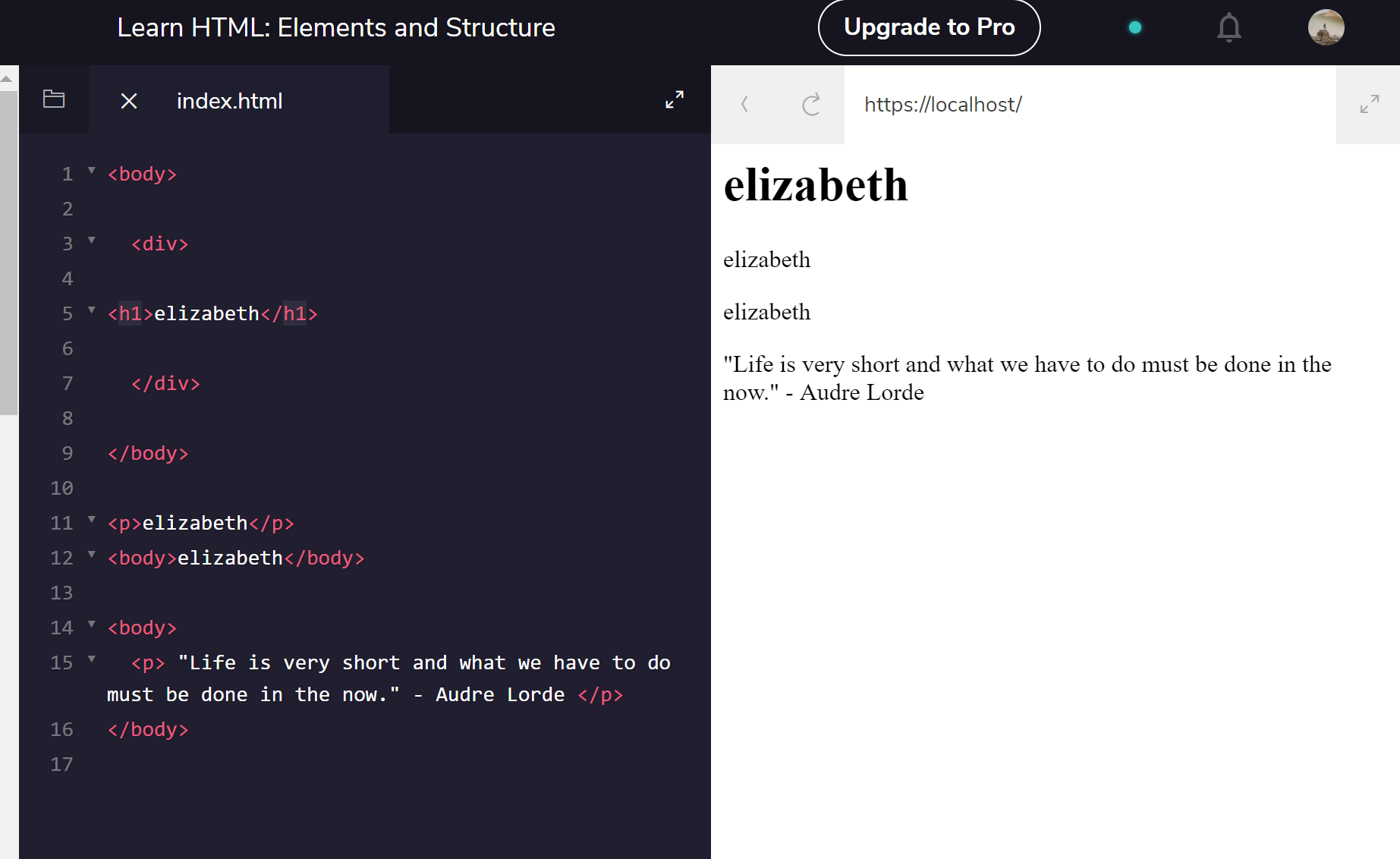
Generally, I’m someone that likes to glance at the directions once and awhile and then figure out something on my own. IKEA furniture sometimes takes me a few tries. Recipes usually turn out okay. Coding required a level of exactness that I don’t often apply. For example, in the first picture, I wanted to vary the size of my name. However, at first, I couldn’t figure out what I was doing wrong as I spent time playing with the code.

Screenshot by Me of “LearnHTML: Elements and Structure”

Then, I went a page or two farther in the lesson and figured it out based on a later lesson. I went back and fixed it. There is my name in <h1> size.

Screenshot by Me of “LearnHTML: Elements and Structure”

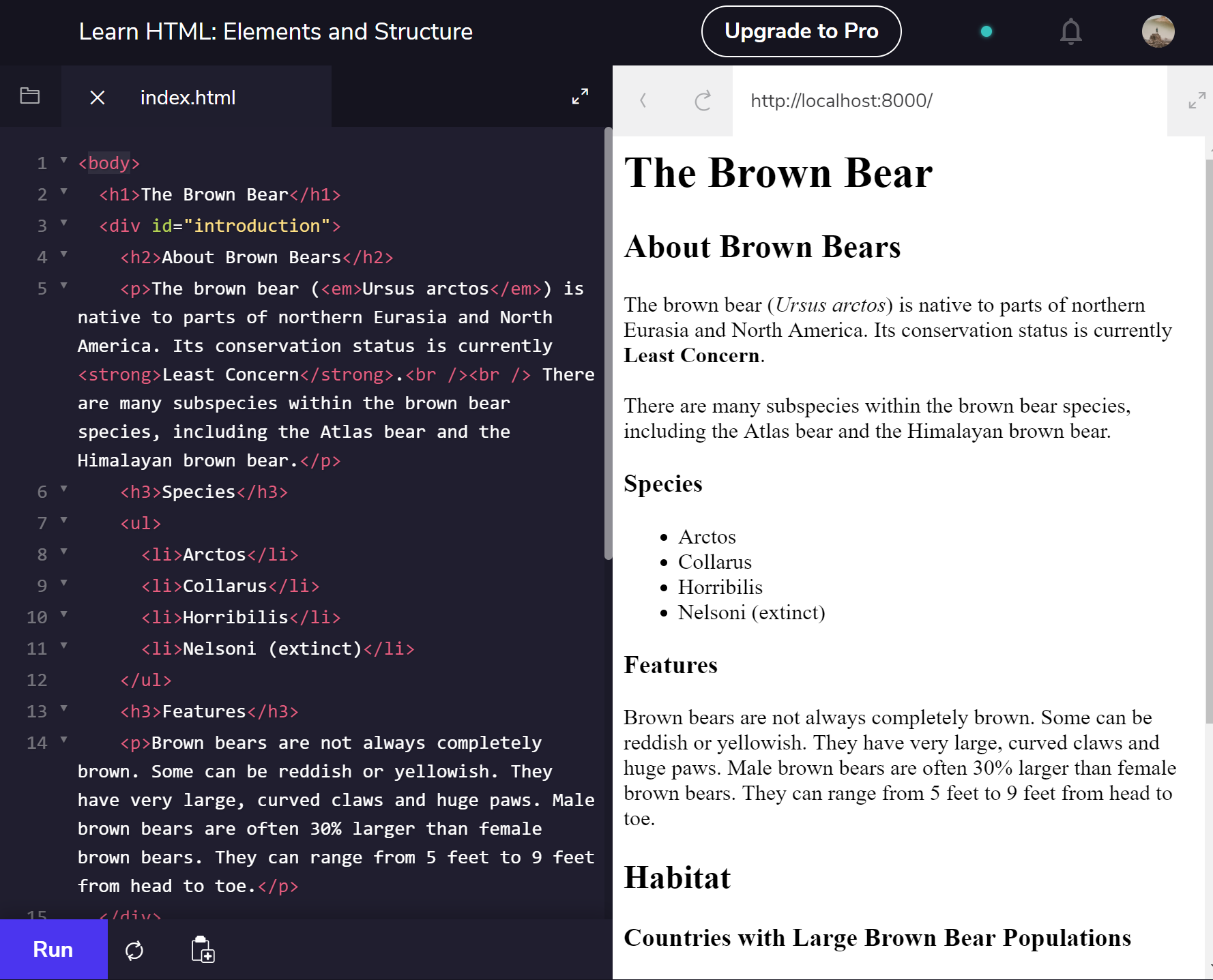
While I ran into a few other moments where I couldn’t quite figure out what I was doing wrong, I appreciated the hints and solutions Codecademy offers. Those kept me from getting frustrated and provided clear explanation and examples of what I was doing wrong. While perhaps those hints and solutions are nearing a hot media, I was intrigued enough to learn from my errors and move forward to do a similar task correctly in the next lesson.

Screenshot by Me of “LearnHTML: Elements and Structure”

In the introduction of the lesson, it explained that on any web page, I can right click and select “Inspect” to see the code for that page. I’ve definitely tried it on a few web pages since then. This process was especially my “seeing behind the curtain” moment. For example, on the Blackboard pages I’ve spent so much time on the last six months, there is a whole layer of text and meaning that I don’t fully understand. However, a few minutes ago when I clicked “Inspect” for this blog page, I found that I could understand a bit of what was being communicated in the code. I’m casually learning Arabic right now, and the readability of code is similar to the readability of the Arabic children’s book someone gave me for Christmas. I get little bits. I can make out what it means here and there. However, I have a long way to go in understanding HTML and Arabic.

Thinking of McLuhan’s axiom, “the medium is the message,” it’s interesting to think how the HTML of a website and what the average person sees communicates such a different message (19). One communicates structure and order. The other communicates content. However, to a skilled coder, I wonder if the HTML might be able to communicate the message of the plain text. Reading code, I’m sure, is an experience where hot and cold changes based on the person involved in the process.

Nicolas Gane and David Beer consider Castell’s view of information, writing that he proposes “that there exists a basic distinction between knowledge on one hand, and information on the other” (47). A first lesson in coding illustrations this idea. I had before me the information of coding on Codecademy. However, my knowledge of coding is not equal to the amount of information that was before me in the lesson. Understanding could be an added layer, as one can know information but then needs understanding in order to apply it.

Works Cited

Gane, Nicholas and David Beer. “Information.” New Media: The Key Concepts, Berg, 2008, pp. 35-52.

“Learn HTML: Elements and Structure.” Codecademy, 2019.

McLuhan, Marshall. “Media Hot and Cold.” Understanding Media: The Extensions of Man, edited by W. Terrence Gordon, Ginko Press, pp. 38-50.

McLuhan, Marshall. “The Medium is the Message.” Understanding Media: The Extensions of Man, edited by W. Terrence Gordon, Ginko Press, pp. 18-35.