In his chapter “Media Hot and Cold” in Understanding Media: The Extensions of Man, Marshall McLuhan distinguishes between hot and cold media by the level of participation of the person receiving the media and its content (39). Going through Codecademy’s “Learn HTML: Elements and Structure” was most definitely a cold media, requiring my full attention and participation.
Generally, I’m someone that likes to glance at the directions once and awhile and then figure out something on my own. IKEA furniture sometimes takes me a few tries. Recipes usually turn out okay. Coding required a level of exactness that I don’t often apply. For example, in the first picture, I wanted to vary the size of my name. However, at first, I couldn’t figure out what I was doing wrong as I spent time playing with the code.

Then, I went a page or two farther in the lesson and figured it out based on a later lesson. I went back and fixed it. There is my name in <h1> size.
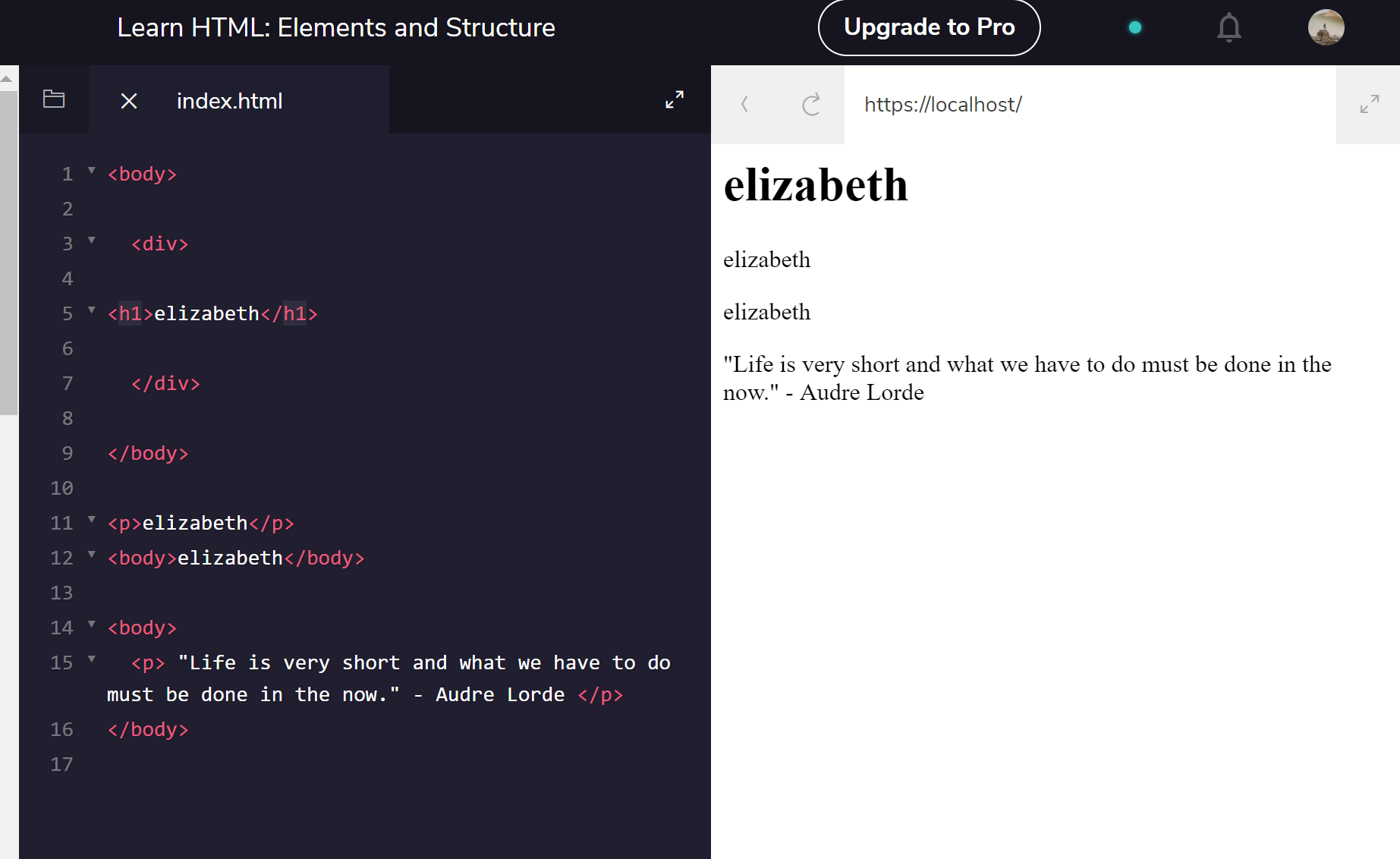
While I ran into a few other moments where I couldn’t quite figure out what I was doing wrong, I appreciated the hints and solutions Codecademy offers. Those kept me from getting frustrated and provided clear explanation and examples of what I was doing wrong. While perhaps those hints and solutions are nearing a hot media, I was intrigued enough to learn from my errors and move forward to do a similar task correctly in the next lesson.
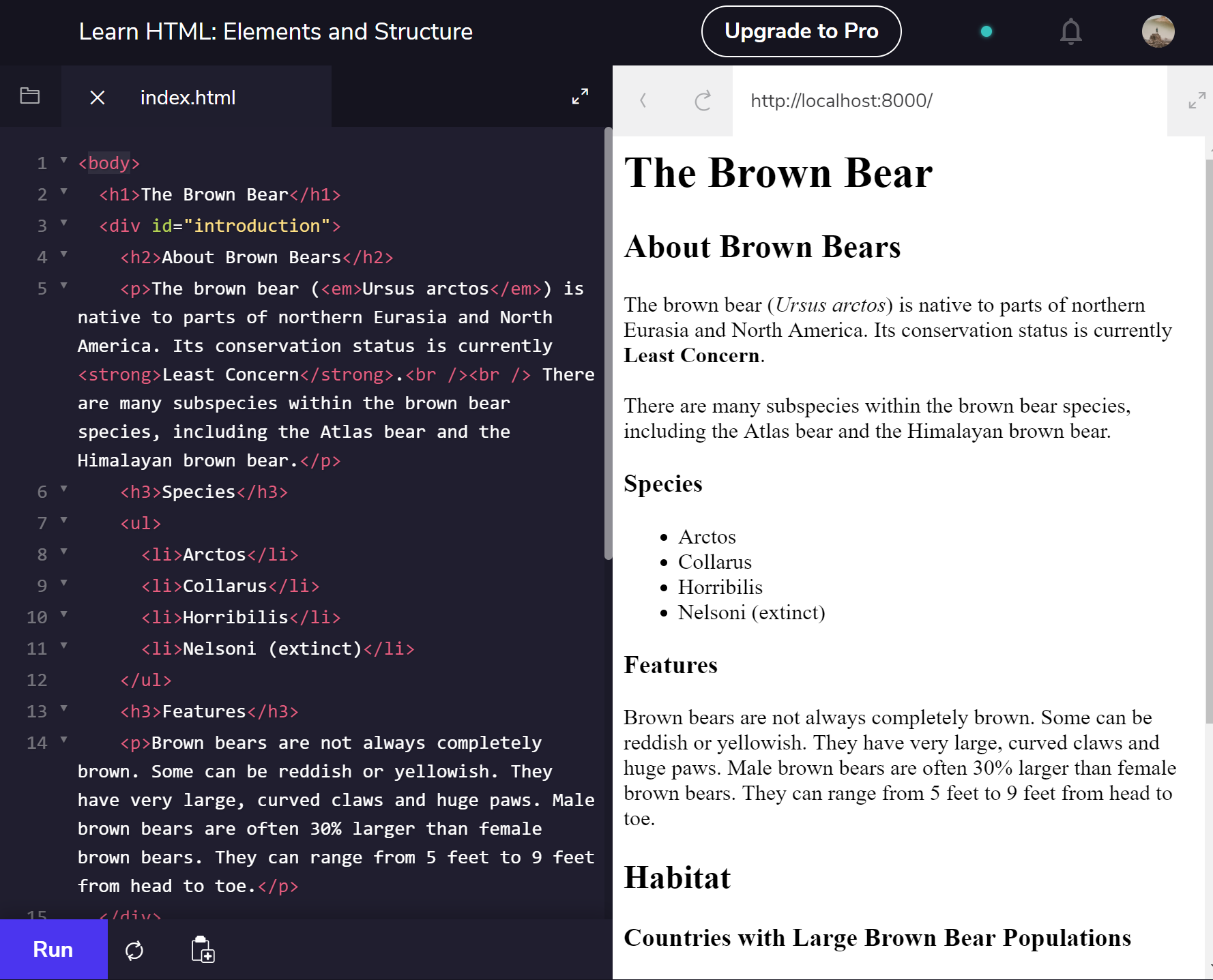
In the introduction of the lesson, it explained that on any web page, I can right click and select “Inspect” to see the code for that page. I’ve definitely tried it on a few web pages since then. This process was especially my “seeing behind the curtain” moment. For example, on the Blackboard pages I’ve spent so much time on the last six months, there is a whole layer of text and meaning that I don’t fully understand. However, a few minutes ago when I clicked “Inspect” for this blog page, I found that I could understand a bit of what was being communicated in the code. I’m casually learning Arabic right now, and the readability of code is similar to the readability of the Arabic children’s book someone gave me for Christmas. I get little bits. I can make out what it means here and there. However, I have a long way to go in understanding HTML and Arabic.
Thinking of McLuhan’s axiom, “the medium is the message,” it’s interesting to think how the HTML of a website and what the average person sees communicates such a different message (19). One communicates structure and order. The other communicates content. However, to a skilled coder, I wonder if the HTML might be able to communicate the message of the plain text. Reading code, I’m sure, is an experience where hot and cold changes based on the person involved in the process.
Nicolas Gane and David Beer consider Castell’s view of information, writing that he proposes “that there exists a basic distinction between knowledge on one hand, and information on the other” (47). A first lesson in coding illustrations this idea. I had before me the information of coding on Codecademy. However, my knowledge of coding is not equal to the amount of information that was before me in the lesson. Understanding could be an added layer, as one can know information but then needs understanding in order to apply it.
Works Cited
Gane, Nicholas and David Beer. “Information.” New Media: The Key Concepts, Berg, 2008, pp. 35-52.
“Learn HTML: Elements and Structure.” Codecademy, 2019.
McLuhan, Marshall. “Media Hot and Cold.” Understanding Media: The Extensions of Man, edited by W. Terrence Gordon, Ginko Press, pp. 38-50.
McLuhan, Marshall. “The Medium is the Message.” Understanding Media: The Extensions of Man, edited by W. Terrence Gordon, Ginko Press, pp. 18-35.

 The Ordinary Pebble
I’m so glad you enjoyed your CodeAcademy adventure, E. You make an excellent point about code appearing hot/cold depending on the person’s background knowledge of the code structure. And I’m thrilled that you spent time looking at the HTML behind this WordPress blog, which was a suggestion I was going to make in this week’s announcement.
LikeLike